

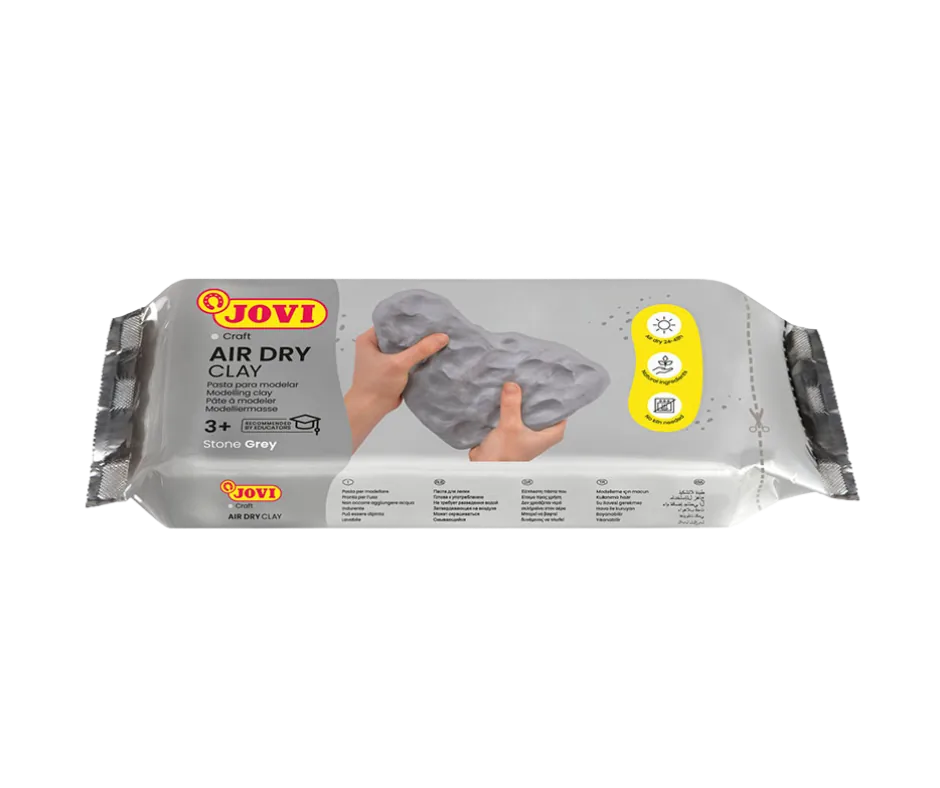
Ask this question online and you get "24 to 48 hours" from every source, because that is what the pack says. It is not wrong — it is measured in standard conditions, roughly 23°C and 50% relative humidity. Malaysian ambient humidity sits closer to 75–85%, and an art room without air conditioning in November is a different environment altogether.
This matters most to teachers, because a lesson planned around 48 hours and met with soft bases on day three looks like a product fault. It isn't. It's a planning problem, and it is entirely avoidable once you plan around weight rather than around the number on the bag.
Real drying times, by project weight
Thickness drives drying time far more than surface area does. A wide, thin tile dries quickly; a small solid lump does not. These are the ranges we see in Malaysian classrooms and homes.
| Project | Clay per piece | Air-conditioned room | No air conditioning |
|---|---|---|---|
| Impression tile, small pinch pot | 150–200 g | 24 hours | 24–36 hours |
| Relief tile, carved surface | 300 g | 36–48 hours | 48–60 hours |
| Pierced lantern, hollow form | 350 g | 48 hours | 48–72 hours |
| Standing planter, solid base | 500 g | 48–72 hours | 72 hours or more |
Add time again during the monsoon months. The practical rule for a scheme of work: plan the painting session for the lesson after next, not the next one. If your art lessons are weekly, that is automatic. If you teach the same class twice in a week, thin the work down or accept that painting slips a week.
Four things that decide whether a piece survives
1 · Turn every piece at half-time
The base sits flat against a board and gets no air, so it dries last and least. Turning each piece once, halfway through, is the single highest-return habit in the whole process. It costs two minutes of a lesson and it prevents most of the "still soft underneath" problems.
2 · Even walls, not thick walls
Cracks are a drying-rate problem, not a clay-quality problem. Where a thick section meets a thin one, the thin part shrinks first and the join tears. Hollow out anything chunkier than a thumb, keep walls roughly even, and score-and-slip every join. This is why the pinch-pot technique is taught before anything ambitious.
3 · Slower is safer
A fan moving air across the room helps. A hairdryer pointed at the work, an oven, or direct sun on a windowsill do the opposite — they dry the skin while the core stays wet, and the shrinking outer layer splits. If a deadline is tight, the fix is thinner work, never harder drying.
4 · Test with the back of your hand
Dry clay is chalk-white all over and room temperature. Clay that still feels cool is still holding water, however dry the surface looks. This is worth teaching to a class as a check they can do themselves — it turns "is it ready?" from a question for the teacher into something the student can answer.
Repair, don't restart. A crack while the clay is still damp closes if you work a slip of clay and water into it with a finger and smooth over. A break after the clay has hardened holds permanently with ordinary white PVA glue.
Tell a class this before it happens. A child who knows a break is fixable takes more risks with the making, which is the whole point.
Storing an opened pack in a hot climate
Unopened, air drying clay keeps indefinitely. Once opened, it is on a clock — and in tropical heat that clock runs faster than most people expect.
Reseal the bag airtight, tuck a slightly damp cloth or sponge in with the clay, and store it in a cool cupboard out of the sun. Kept that way it stays workable for weeks. What you should not do is leave an opened bag in a store cupboard that bakes over a school holiday: opened clay in tropical heat can develop mould spots or a sour smell, and clay in that state should be thrown away rather than handed to a class. Label opened packs with the date and use them within the term.
Painting, sealing and dust
Tempera and acrylic both take well on fully dried clay. Applied too early, paint lifts, goes patchy and seals moisture inside the piece. For anything that will be handled a lot, or a planter that will hold a real plant, finish with varnish or diluted PVA.
On dust: the honest answer is that there needn't be any. Do not dry-sand finished work. Smooth surfaces with a damp sponge before the clay hardens and there is nothing to sand later — no dust, no extraction equipment, no issue for a student with asthma. If an edge does need refining after drying, damp-sand it. And clear up with a damp cloth rather than a brush; sweeping dry crumbs is what puts particles in the air.
Teachers: this page is a condensed version of the drying and troubleshooting guidance in the free JOVI Art Teacher's Guidebook — six no-kiln clay units mapped to Cambridge, IGCSE 0400 and IB MYP/DP, with per-student quantities and costs. Free to download, no purchase required.
Common questions
How long does air dry clay take to dry in Malaysia?
Between 24 hours and about three days, depending on thickness and whether the room is air-conditioned. A thin 150 g tile is usually ready in 24 hours; a 500 g standing form in a non-air-conditioned room during the monsoon can take 72 hours or more.
Why is my clay still soft after two days?
Almost always one of three things: the piece is thicker than it looks, the base has been flat against a board so no air has reached it, or humidity is high. Turn it over, move it somewhere with moving air, and give it another day. Don't use an oven or direct sun.
Why does air dry clay crack, and can I fix it?
Uneven drying — either the surface drying much faster than the core, or thick and thin sections shrinking at different rates. While damp, work a slip of clay and water into the crack. Once hard, white PVA glue is a permanent repair.
Can I speed it up with a hairdryer or oven?
No. A fan across the room is fine and helps. Aimed heat dries the skin while the core stays wet, which is the most reliable way to crack a piece. If time is short, make the work thinner instead.
How do I store an opened pack?
Airtight bag, a slightly damp sponge inside, cool cupboard away from sun — workable for weeks. Use opened stock within the term; discard any pack showing mould spots or an off smell.
When can I paint it?
When it is chalk-white all over and room temperature, not cool, against the back of your hand. Tempera or acrylic both work. Seal with varnish or diluted PVA if it will be handled.
Questions about a specific project, or planning clay into a scheme of work? WhatsApp +60 13-606 7062 or email [email protected] — we reply within one working day.