

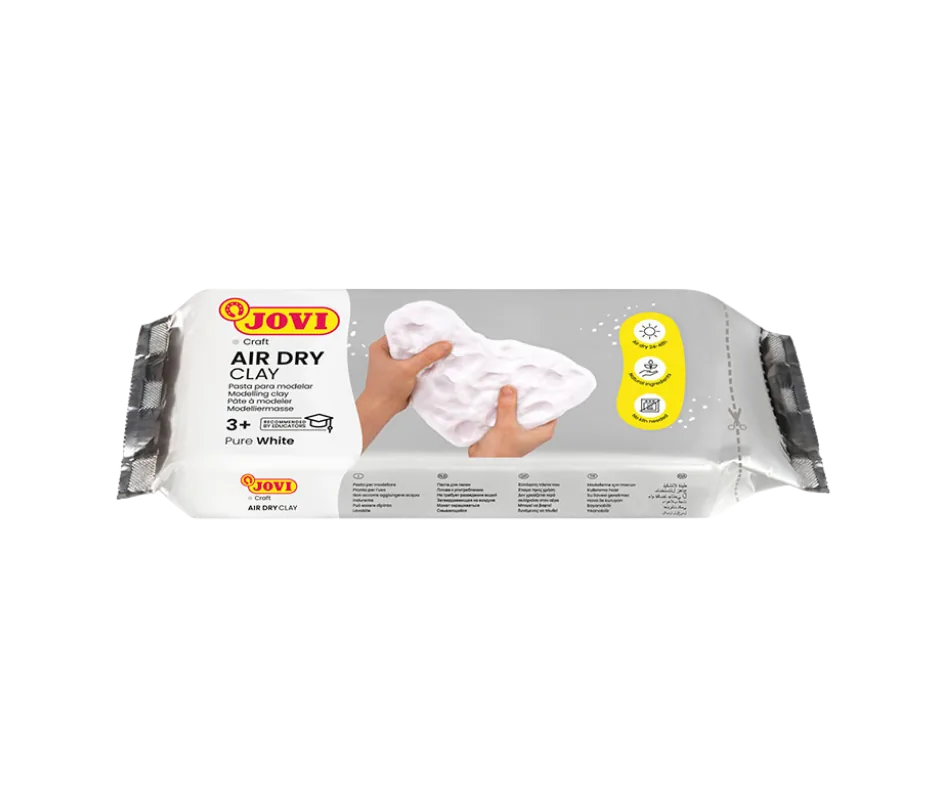
A clay ring dish is the first project we recommend to anyone holding clay for the first time. It takes 20 minutes of active making time, uses less than 100 g of clay, looks beautiful on a bedside table, and teaches every fundamental technique you'll use in larger projects later: kneading, rolling to even thickness, cutting clean edges, draping over a former, and drying without cracks. By the end of the tutorial you'll have a finished object you'd happily give as a gift, and you'll understand exactly how the material behaves.
What you'll need
One 250 g pack of JOVI Air-Dry Clay (any colour — Pure White, Stone Grey or Terracotta all work; Stone Grey is the most forgiving for beginners because dust and fingerprints don't show). A small rolling pin or a clean wine bottle. A round bowl, mug or cup roughly 10–12 cm across to use as a former. A blunt knife or one of the JOVI 5-piece Modelling Spatulas. A piece of baking paper to roll on. A bowl of water and a clean dishcloth.
Step 1: Knead the clay (3 minutes)
Tear off about a fist-sized portion of clay from the pack — roughly 80–100 g. Reseal the rest of the pack immediately in an airtight bag; air-dry clay starts curing the moment it's exposed. Knead the lump in your hands like bread dough for 2 to 3 minutes. The goal is to warm it up, make it pliable, and eliminate any air bubbles inside (air bubbles will cause cracks when the piece dries). When the clay is smooth, uniform, and slightly warm from your hands, you're ready.
Step 2: Roll out the slab (3 minutes)
Place the clay on the baking paper and gently flatten it with your palm. Then roll with the rolling pin in one direction, lift, rotate 90 degrees, and roll again. Keep rotating between rolls — this gives you an even thickness across the whole slab. Aim for 5–6 mm thick. Thinner than 5 mm will warp or crack when drying; thicker than 8 mm will take much longer to cure. If the surface develops small cracks at the edges as you roll, pinch them closed with damp fingers.
Step 3: Cut to size (2 minutes)
Place your round former (the bowl or mug) upside-down on the slab and cut around it with the blunt knife, leaving a 1 cm border. The total disc should be 12–14 cm across. Lift the cut disc carefully off the baking paper. If the edges feel rough, smooth them with a fingertip dipped in water — a technique called 'slipping' that you'll use on every clay project for the rest of your life.
Step 4: Drape and shape (2 minutes)
Turn the former (bowl/mug) right-side-up. Lay the clay disc over it, centred. Gently press the clay down around the curve of the former — don't force it, let it follow the shape naturally. The edges will form a soft ruffled rim. If you want a more sculptural look, pinch three or four points on the rim to create a wave. If you want a clean classical look, smooth the rim flat with a damp finger. Sign the underside with your initials and a date using the tip of a spatula — finished pieces always look more intentional with a maker's mark.
Step 5: Dry slowly (24–72 hours, passive)
Leave the dish draped over the former in a cool, shaded, well-ventilated spot. Direct sunlight or an air-con vent will cause uneven drying and cracks. After 24 hours, gently lift the dish off the former — it should hold its shape. Place it upside-down on baking paper for another 24 to 48 hours to let the underside fully cure. In Malaysian humidity, the full 72-hour cure is conservative; in air-conditioned rooms, 48 hours is usually enough.
Step 6 (optional): Paint and seal
Once fully dry, the dish is ready to use as-is — the matte finish of Stone Grey or Terracotta looks beautiful on a vanity. If you want to paint it, use acrylic paint (cheap craft acrylic from Daiso or Mr DIY works perfectly). Two thin coats give a better finish than one thick one. After painting, seal with two coats of PVA glue thinned 1:1 with water — this gives the dish a soft satin sheen and makes it water-resistant enough to actually hold jewellery without staining.
Troubleshooting
Cracks appearing as it dries? The clay was rolled too thin, or dried too fast in direct sun. Patch with a slip of fresh clay mixed with water, let dry, sand smooth. Surface bumps and lumps? You didn't knead long enough — air bubbles inside the clay caused the surface to puff. Always knead at least 2 full minutes. Edges curling up off the former? Normal — the rim shrinks slightly as it dries. Press it back down gently at the 6-hour mark and it will set in place.
Variations to try after your first dish
Once you've mastered the basic dish, scale up: a 200 g piece makes a side-plate-sized catchall for keys and AirPods near the front door. Texture the slab before draping by pressing lace, leaves, or even bubble wrap into the surface for a printed pattern. Add a second piece of clay rolled into a coil and pressed around the rim as a decorative edge. Use the JOVI Terracotta to imitate fired earthenware — perfect for a Mediterranean look. The same technique scales to plant saucers, candle holders, and tea-light dishes.
What to buy for the next project
If you enjoyed this and want to make more: a 1 kg pack of JOVI Air-Dry Clay (RM48.90) gives you enough for 10 more dishes or one large sculpture. The 5-piece Modelling Spatulas (RM12.50) unlock surface texture and detail work. For colour variety, all three JOVI Air-Dry Clay colours (Pure White, Stone Grey, Terracotta) at RM16.90 each will let you make a co-ordinated set of three matching dishes — popular Hari Raya, Deepavali and Christmas gifts.